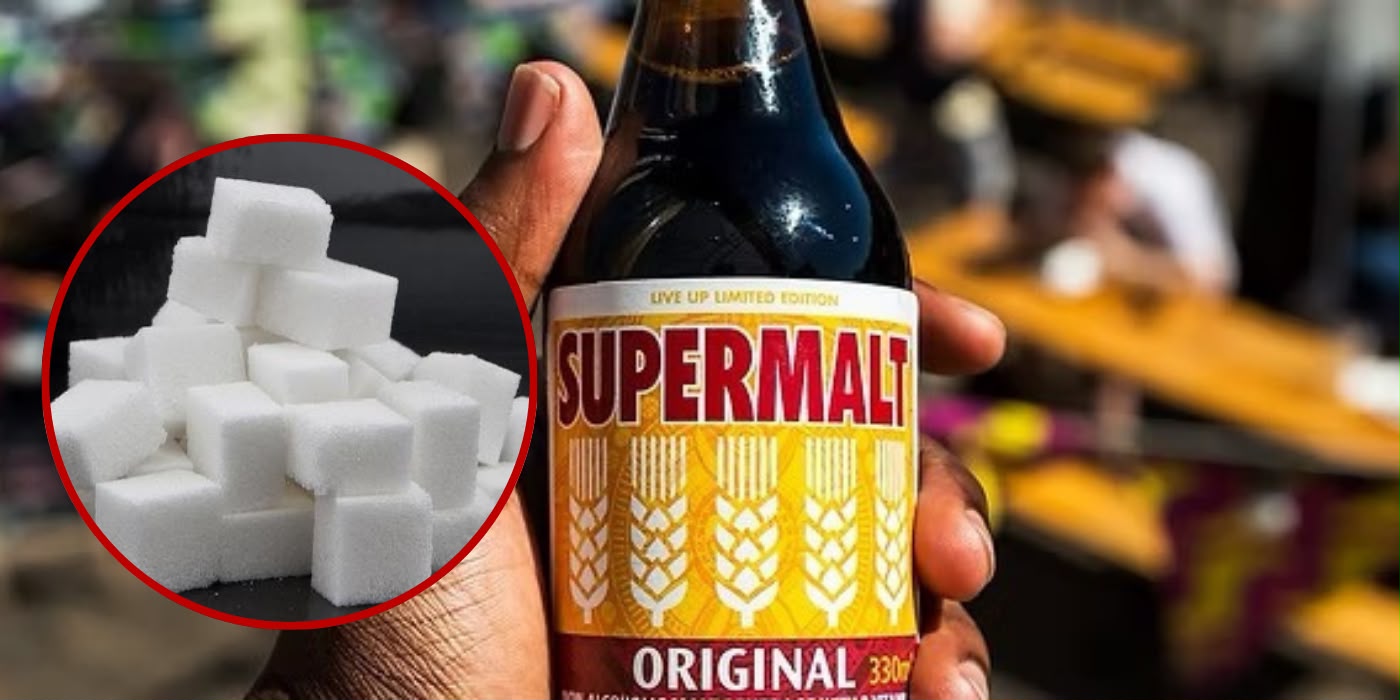

Supermalt lovers have been left questioning their favourite drink after a recent podcast discussion revealed just how much sugar could be packed into a single bottle.
The conversation took place on the Eze Speaks podcast, where host Francesca Ezennolim, better known to many as Fran, sat down with health and wellness expert Alliyah to discuss nutrition, sugar intake and everyday eating habits.
During the discussion, Fran reflected on how frequently Supermalt is consumed within her family and social circles, asking:
"When my brother has Supermalt he has maybe four. If I have Supermalt in a party I'll have about two. If I'm drinking this whole Supermalt what does that look like in my bloodstream?"
Alliyah responded by comparing the drink's carbohydrate content to sugar cubes, explaining:
"The amount of carbs in the Supermalt will be equivalent to about 10 or 12 sugar cubes. So 12 sugar cubes is one bottle of Supermalt."

The revelation visibly shocked Fran, who quickly began calculating what that could mean for those drinking multiple bottles in one sitting.
Later in the conversation she asked:
"Say if I have two Supermalts, that's 24 sugar cubes, what is my limit my body can contain?"
Alliyah replied:
"I think about it in equivalent to what I tell my patients, probably be like 10 to 15 sugar cubes will be like a limit but I'll be like it for a meal, not for a drink."
.jpeg)
The exchange quickly gained attention online, with many viewers expressing surprise at the comparison.
According to NHS guidance, adults should consume no more than 30g of free sugars per day, which is roughly equivalent to seven sugar cubes. Children are advised to consume even less depending on their age. While sugar naturally occurs in some foods and drinks, health experts generally encourage people to monitor their intake of added and free sugars due to links with obesity, tooth decay and other health concerns.
That does not mean people need to completely avoid their favourite treats. Nutritionists often emphasise that enjoying sugary foods and drinks occasionally can form part of a balanced diet, provided overall consumption remains moderate and is combined with healthy eating habits.
.jpeg)
For many people, however, the discussion came as a surprise because Supermalt is often viewed differently from standard fizzy drinks. The non-alcoholic malt beverage has long been a household staple across many African and Caribbean communities, regularly appearing at family gatherings, celebrations, parties and Sunday dinners.
Its distinctive sweet taste and nostalgic connection to home have helped make it a cultural favourite for generations. For many consumers, it is more than just a drink, it is a familiar part of family life and community celebrations.
As clips from the podcast circulated online, reactions ranged from disbelief to humour. One person commented:
"I will not accept any negativity related to Supermalt. Thank you please. Life is hard as it is!!!!!"
Another person said:
"This is the information none of us Supermalt drinkers wanted to hear though.."
A third wrote:
"I was convinced I was drinking the healthiest fizzy drink, KMT! Everything is a scam."
.jpeg)
Others pointed out that many popular soft drinks contain high levels of sugar and argued that the key issue is awareness rather than avoiding particular products altogether.
The discussion has ultimately served as a reminder that some of the foods and drinks we consume most casually can contain more sugar than we realise. For many Supermalt fans, it may not be enough to stop them reaching for a bottle, but it has certainly given them something to think about before opening a second, third or fourth one.
.png)


.png)
.png)
.png)
.svg)
.svg)
.svg)