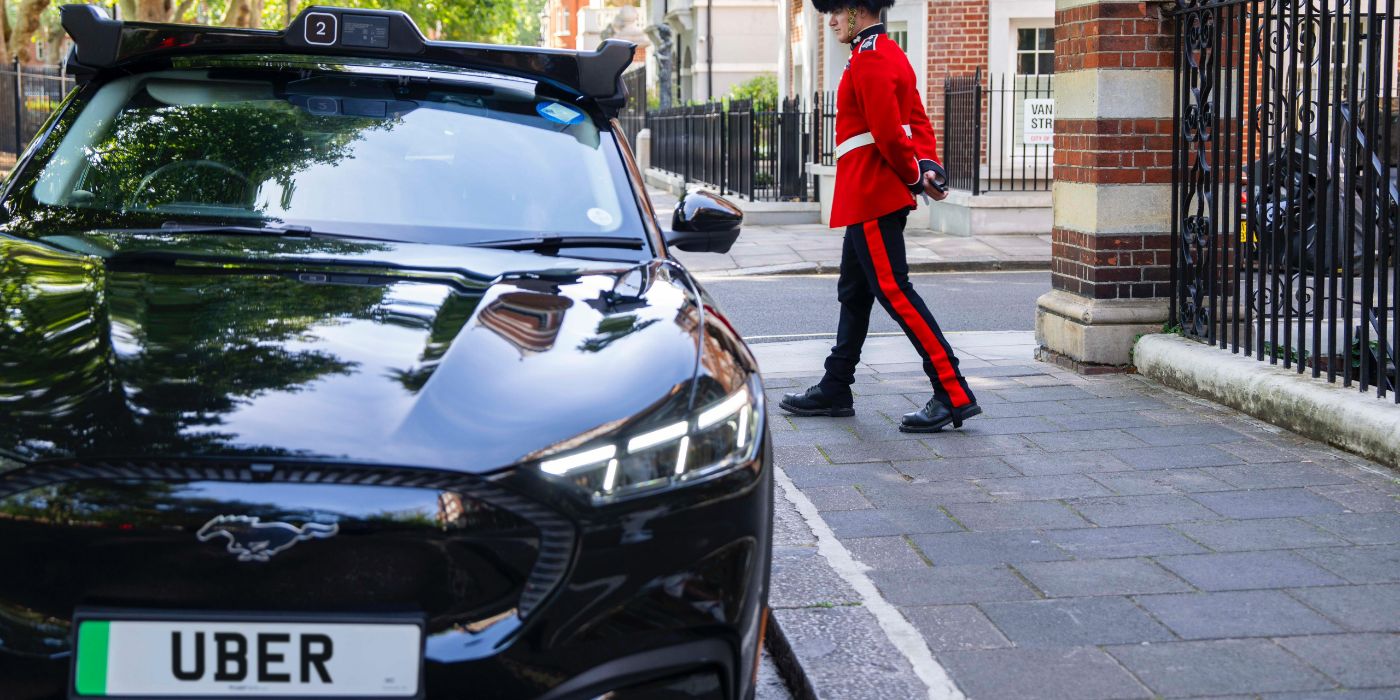

London has entered a new era of transport after Uber and British artificial intelligence company Wayve launched the capital’s first self-driving taxi service, giving passengers the option of travelling in an autonomous vehicle booked through the Uber app.
The service officially launched on Thursday, 3 September, with 15 vehicles currently licensed to operate. While the cars are capable of driving themselves, they are not yet fully driverless, as a licensed human safety driver remains in the front seat throughout each journey and can take control if necessary.
The limited number of vehicles means that customers should not expect to regularly see the autonomous option when requesting an Uber. London has more than 100,000 private hire vehicles, making the initial fleet of 15 self-driving cars extremely small by comparison.
.jpeg)
Around 100,000 Uber customers have reportedly registered their interest in taking an autonomous ride, highlighting the level of curiosity surrounding the technology despite the service still being in its early stages.
The vehicles currently being used are modified Ford Mustangs equipped with Wayve’s autonomous driving technology. The cars can be requested and unlocked through the Uber app, with passengers informed by the safety driver about how the service operates.
Although a human will be sitting in the driving seat, their role is different from that of a conventional taxi or private hire driver. The driver is there primarily to supervise the technology and intervene if required, rather than actively controlling the vehicle throughout the journey.
The current arrangement is therefore being viewed as a stepping stone towards fully autonomous taxis, rather than the final version of the service.
Wayve chief executive and co-founder Alex Kendall said the company was proud to introduce its AI Driver technology to the public in London, describing the capital as:
"Our home city and one of the most complex driving environments in the world".
Kendall acknowledged that the technology is still developing, but said the company is working towards eventually removing the safety driver altogether. He said:
"I don’t want to put a timeline on it, but we’re pushing as fast as we can."
Wayve is also preparing to move away from the limited fleet currently being used and towards vehicles that can be produced on a larger scale. The company is developing Nissan Leaf robotaxis fitted with its technology, but these will still need to pass further safety validation and receive the necessary regulatory approval before they can operate without a human supervisor. Kendall said:
"We’re working on all three in parallel. As soon as they come together, we’ll launch [fully] driverless services."
.jpeg)
Wayve’s approach differs from some of its competitors because its self-driving system is based around an AI learning model rather than relying primarily on detailed mapping. The company has been testing its technology on London’s roads, which present a particularly complicated environment for autonomous vehicles because of heavy traffic, pedestrians, cyclists, buses, roadworks and the capital’s often unpredictable driving conditions.
The arrival of the service represents a significant step for the UK's autonomous vehicle industry, but it has also raised questions about what widespread use of the technology could mean for people whose livelihoods depend on driving.
Some members of the public have already expressed concern about the potential consequences, particularly if autonomous taxis eventually become capable of operating without a safety driver.
Reacting to the news, one person said:
"Umm, I’m not sure about this. I see this as a way to get rid of jobs."
Another commented:
"Anybody that supports this is crazy.."
A third person raised concerns about safety, writing:
"Nope. I’ve seen this go wrong in one too many movies. I’ll continue to support the working man and woman thanks!"
However, not everyone was against the development, with one person taking a more practical view of the potential benefits, saying:
"If its cheaper, yeah why not!?"
The concerns are not limited to online reactions. The prospect of autonomous vehicles replacing human drivers has become an increasingly important issue for trade unions and people working across the taxi and private hire industry.
David McMullen, a senior organiser at the GMB union, warned that the introduction of driverless vehicles could have significant consequences for employment if the technology becomes widely adopted. He said:
"With hundreds of thousands of people employed to drive every day, we need to be really careful with the rollout of driverless cars unless we are prepared to see unprecedented levels of social and economic disruption."
The concern is particularly relevant because driving is a major source of employment across the UK. If autonomous taxis eventually become cheaper to operate than vehicles with human drivers, companies could have an incentive to reduce the number of people they employ or rely on through their platforms.
Uber, however, has pushed back against the idea that autonomous vehicles will immediately replace its existing drivers.
.jpeg)
Sarfraz Maredia, Uber’s head of autonomous mobility, acknowledged that the company had heard concerns from drivers but argued that the complexity of London’s roads could make it difficult for autonomous vehicles to compete with experienced human drivers in the near future. He said:
"One of the most common ones we hear from our drivers is: ‘Hey, I drive in this city and it’s very complex, and I don’t think this product is going to be able to compete with me anytime soon.’"
Maredia also said Uber intended to continue operating with both human drivers and autonomous vehicles, adding:
"We always want Uber to be a platform where both human drivers and AVs can operate, and because the market and our business are still growing here we think that’s going to be true for a long time."
Cost is another major question surrounding the technology. One of the arguments in favour of autonomous taxis is that removing the need for a human driver could eventually reduce the cost of each journey, potentially making taxis more affordable for passengers.
However, that is not currently the case. Maredia said:
"The benefit for consumers should be, over time, that it’s both safer and cheaper. Today, nobody’s able to operate AVs cheaper than a traditional human-driven ride, so that’s going to take a while to prove."
This means passengers should not assume that booking an autonomous Uber will automatically result in a cheaper fare. The technology remains expensive to develop and operate, and the current requirement for a human safety driver means one of the major potential savings associated with full autonomy has not yet been realised.
Safety is another area that will remain under close scrutiny as the service expands.
.jpeg)
The current London vehicles have been licensed by Transport for London as private hire vehicles, but their licence conditions require a safety driver to supervise the autonomous system. Fully autonomous operation without someone behind the wheel requires separate regulatory approval through the Driver and Vehicle Standards Agency. That approval is not currently expected to be granted this year.
London is also becoming an increasingly important testing ground in the global race to develop autonomous taxis. Wayve is not the only company pursuing the technology in the capital, with Google-owned Waymo and Chinese technology company Baidu also testing robotaxis in London.
Fully driverless taxi services are already operating in several cities around the world, particularly in the United States, China and the United Arab Emirates. Uber also partnered on a commercial robotaxi service in Zagreb, Croatia, earlier this summer, where vehicles similarly operated with a human driver onboard.
The London launch therefore gives Uber and Wayve an opportunity to test how autonomous vehicles perform in one of Europe's busiest and most complicated cities, while also allowing the companies to gather more information about how passengers respond to the experience.
.jpeg)
For customers, the idea of getting into a car without a conventional driver may still feel unfamiliar. For drivers, however, the development raises much bigger questions about the future of their jobs and whether autonomous technology will eventually become a replacement rather than an additional option.
For now, London’s first self-driving taxis remain a relatively small experiment, with just 15 vehicles operating under human supervision. But the long-term ambition is considerably bigger.
If Wayve can demonstrate that its technology is safe, reliable and capable of handling London's roads, and if regulators approve fully autonomous operation, the number of vehicles could eventually increase substantially.
The launch therefore marks the beginning of what could become a major change to the way people travel around the capital, while leaving an important question unanswered, whether self-driving taxis will ultimately work alongside human drivers or gradually reduce the need for them.
.png)



.png)
.svg)
.svg)
.svg)